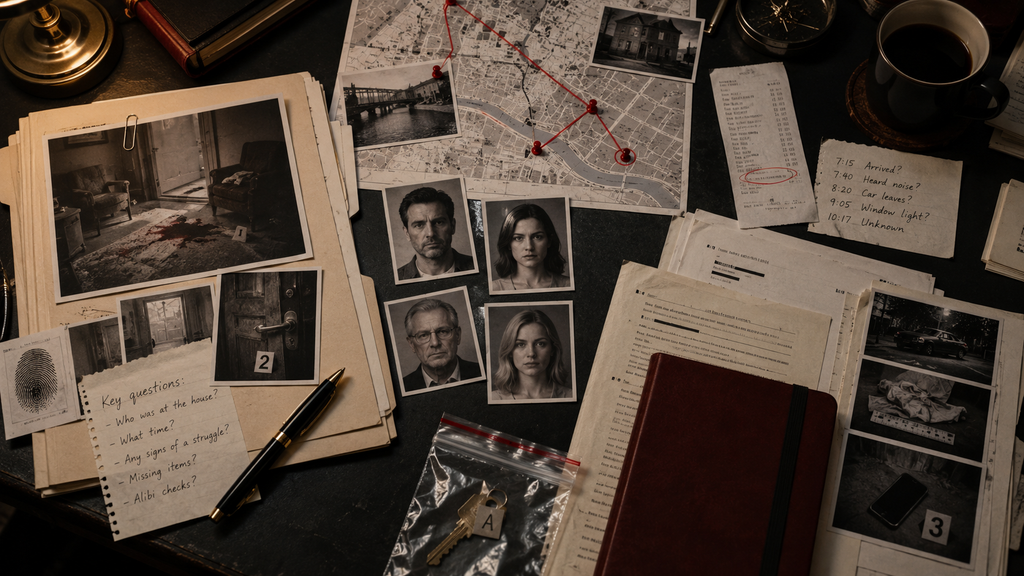
A murder mystery game can turn an ordinary evening into an investigation. One minute you’re reading a witness statement. The next, you’re comparing timelines, questioning someone’s alibi, or discovering that a seemingly insignificant document changes everything.
Printable murder mystery games make that experience accessible from home. Instead of waiting for a physical box to arrive, you download the materials, print them if you prefer, and begin investigating.
But not every printable mystery offers the same experience.
Some are designed for parties where guests play fictional characters. Others are built around puzzles, codes, and riddles. Then there are case-file investigations, where players examine evidence and attempt to reconstruct what actually happened.
Before choosing a game, it’s worth understanding what you’re getting. Here are seven things to look for when buying a printable murder mystery game.
1. Know What Kind of Murder Mystery You’re Buying
The term murder mystery game covers several different experiences, and this is probably the most important distinction to understand before making a purchase.
Murder mystery party games usually assign characters to players. You might receive a character biography, secret objectives, and information to reveal throughout the evening. These games emphasize social interaction, performance, and roleplaying.
Puzzle-focused mystery games challenge players to solve codes, decipher messages, uncover hidden information, and work through a sequence of puzzles. The story provides context for those challenges.
Case-file investigation games put players in the role of detectives. Rather than acting as suspects, they investigate them. Players examine evidence such as witness interviews, forensic reports, photographs, records, and timelines to determine what happened.
These approaches can overlap, and none is inherently better than another.
The important question is what you actually want to spend your evening doing.
If you enjoy performing a character, a murder mystery party might be ideal. If you’re looking for brainteasers, a puzzle-heavy mystery may be the better fit.
But if you want to sit around a table, spread out the evidence, debate conflicting accounts, and build a case against a suspect, look for a deduction-focused case-file investigation.
Related reading: What Is a Murder Mystery Case File Game?
2. Look for a Substantial, Varied Collection of Evidence
One of the biggest attractions of a case-file murder mystery is the opportunity to examine an actual collection of investigative materials.
A substantial evidence packet can make the experience feel much closer to investigating a real case than working through a handful of disconnected clues.
Look for games that offer several types of evidence, such as:
- Witness and suspect interviews
- Crime scene photographs and diagrams
- Forensic or medical findings
- Phone records, messages, and emails
- Receipts, schedules, and business documents
- Surveillance records and movement logs
- Personal records that reveal relationships or motives
Having a wide variety of materials matters because different documents can serve different investigative purposes.
A witness interview might establish an alibi. A receipt might challenge it. A surveillance record could narrow the timeline, while another document provides a possible motive.
The satisfaction comes from discovering how those pieces connect.
The amount of evidence is worth considering, especially if you want a longer, more involved investigation. A case with dozens of exhibits can offer more information to evaluate and more opportunities to build competing theories than a small, self-contained puzzle.
However, look for variety and meaningful connections alongside the quantity. The strongest case files give players reasons to revisit evidence as new information changes their understanding.
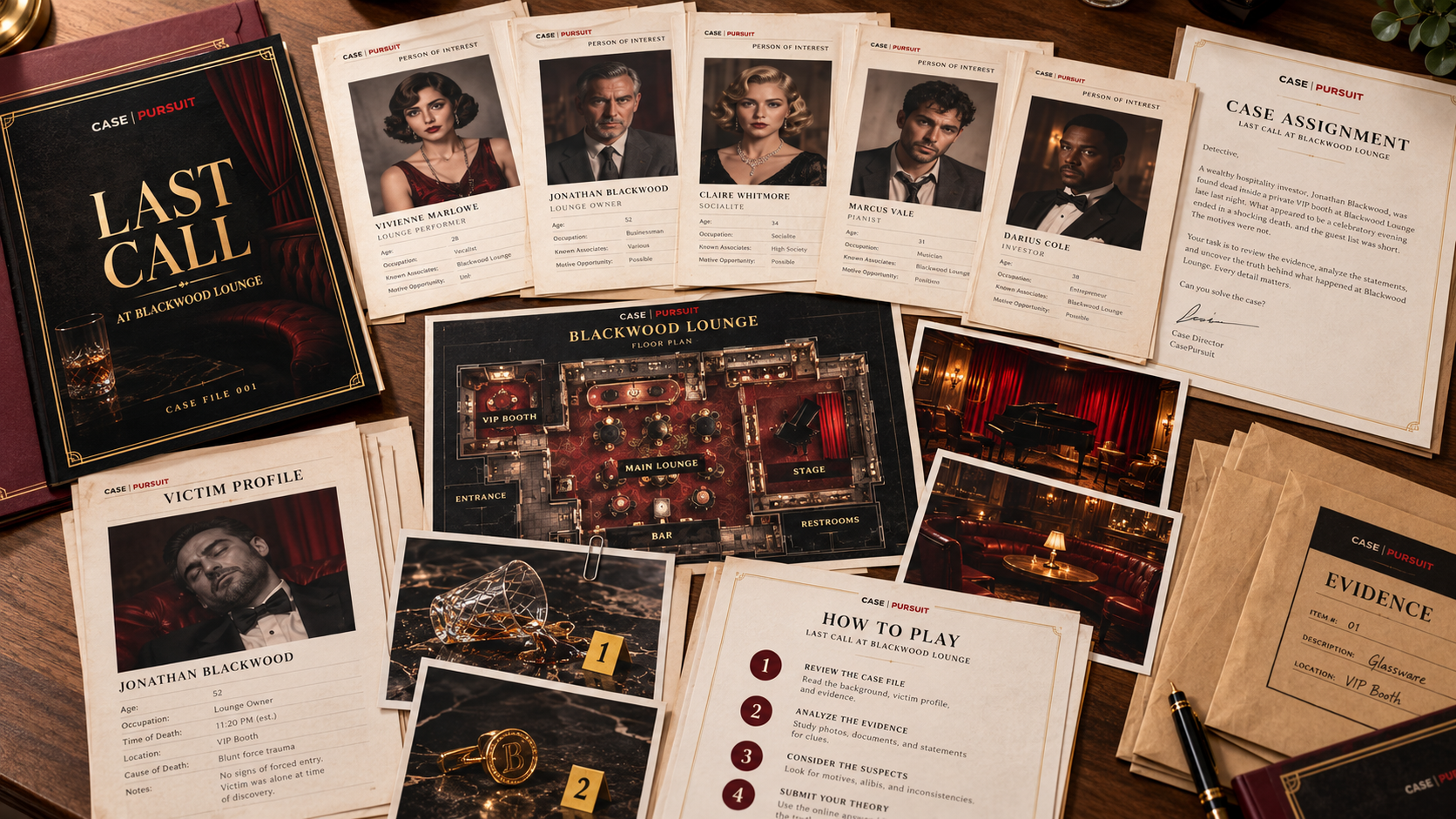
For example, Last Call at Blackwood Lounge from CasePursuit includes more than 55 pieces of evidence and nine suspects. The investigation is built around examining documents, comparing accounts, and connecting information to form a defensible conclusion.
If you enjoy digging into the details rather than rushing toward an answer, the size and depth of the case file should be part of your buying decision.
3. Check Whether the Mystery Rewards Deduction
There’s a difference between discovering the answer to a puzzle and proving a theory about a crime.
In a deduction-focused murder mystery, the challenge should come from interpreting the evidence.
You might encounter several suspects with plausible motives. Their interviews may appear consistent at first, but another document could reveal that someone’s account doesn’t fit the established timeline.
That contradiction becomes meaningful because you can explain why it matters.
Ideally, you should be able to answer questions such as:
- What evidence supports this suspect’s involvement?
- Which statements can be independently verified?
- Does the timeline allow the crime to have happened this way?
- Is there evidence that contradicts the leading theory?
- Can the conclusion be defended using information available to the player?
A satisfying investigation doesn’t require every clue to be obvious. Some connections should take work to recognize.
But difficulty should come from the reasoning, not from needing to guess what the designer was thinking.
When evaluating a game, look for descriptions that mention interconnected evidence, suspect interviews, timelines, and investigative reasoning. These may indicate a more deduction-oriented experience.
If possible, read the gameplay description carefully and look for examples of how players interact with the evidence.
For players who love the moment when several seemingly unrelated details finally fit together, this distinction can make the difference between an entertaining puzzle and a memorable investigation.
4. Understand What You’ll Actually Need to Print
One of the main advantages of printable murder mystery games is convenience. You can purchase and access the materials without waiting for shipping.
However, printing requirements can vary significantly.
Before buying, check whether the game is delivered as a PDF, whether it includes separate files, and whether printing everything is necessary.
Some games are designed primarily for paper-based play. Others can also be viewed on a tablet, laptop, or computer.
If you plan to print the case, consider the following:
- Color versus black and white: Does the game rely on colored details, or can it be played effectively with a standard home printer?
- Printer-friendly files: Does the publisher provide a version designed to reduce ink usage?
- Document organization: Can you easily distinguish different evidence pieces and organize them while investigating?
- Digital compatibility: Can you read the documents on-screen if you don’t want to print everything?
- Additional materials: Does the game require special props, envelopes, or other supplies?
For some players, printing and physically organizing the documents is part of the appeal. They enjoy laying out photographs, highlighting statements, and taking notes directly on the evidence.
Others prefer to investigate digitally.
CasePursuit’s Last Call at Blackwood Lounge, for example, includes both a color edition and a printer-friendly edition. Players can print the case file for a tabletop investigation or review the documents digitally.
The best choice is the format that allows you to focus on the investigation rather than the setup.
5. Match the Difficulty, Playtime, and Player Count to Your Group
A good murder mystery needs enough time for players to become invested in the investigation.
But the right amount of time depends on the experience you’re looking for.
Some printable mysteries are short activities designed to be completed in a single sitting. Others are full investigations involving substantial evidence, multiple suspects, and several hours of discussion.
Before buying, check the estimated playtime and recommended number of players.
For a casual evening, you might prefer a shorter mystery that can be completed quickly. For a dedicated detective game night, a longer case can give everyone more opportunities to explore the evidence and discuss different theories.
Also consider how the game handles multiple players.
Can everyone examine the same documents and collaborate? Do players have individual roles? Is the experience suitable for solo investigation?
These details affect how the game feels at the table.
Last Call at Blackwood Lounge is designed for one or more players, with an estimated playtime of 90–150+ minutes. Players work through the same investigation, whether they’re solving independently or collaborating as a group.
If you’re choosing a mystery for a date night, you may want a game that encourages discussion and teamwork. If you’re organizing an evening with friends, look for enough investigative depth to keep everyone involved.
Related reading: Murder Mystery Games for Couples: How to Choose the Right One
6. Find Out How Hints, Additional Evidence, and Solutions Work
One detail that’s easy to overlook is how the game handles information you aren’t supposed to see immediately.
Some printable mysteries provide every document at the beginning. Others introduce additional materials as the investigation progresses.
For example, a game might require players to solve a code, identify a password, or discover information within the evidence to access another part of the case.
This can introduce a sense of progression while preserving the core investigative experience.
Before buying, it’s worth asking:
- Are all the materials available immediately?
- Does the game include optional or required digital elements?
- Can players access hints if they get stuck?
- Is the solution kept separate from the investigative materials?
- How do players submit or check their final theory?
Ideally, a hint system should help players continue without unnecessarily revealing the answer.
Keeping the solution separate is also important. Nobody wants to accidentally discover the culprit while opening the evidence packet.
CasePursuit combines printable case materials with optional digital viewing and online evidence unlocks. In Last Call at Blackwood Lounge, players can use information from the investigation to access additional case materials, then submit their theory online to unlock the official resolution.
This approach blends a traditional tabletop investigation with interactive elements without requiring players to treat the game like a conventional video game.
If you prefer a completely offline experience, check those requirements before purchasing. If you enjoy uncovering additional evidence as you progress, online unlocks may be a feature worth seeking out.
7. Look for Signs of Thoughtful Design and Playtesting
A murder mystery can have an intriguing premise, attractive documents, and a long list of suspects, but the investigation still needs to hold together.
That becomes especially important in a case-file game, where players are expected to scrutinize details.
If a witness’s timeline contradicts the physical evidence, that contradiction should mean something. If a clue is essential to the solution, the player should have a fair opportunity to discover and interpret it.
Good mystery design requires careful attention to consistency, clarity, and whether players can reasonably reach the intended conclusion.
When evaluating a printable game, look for information about its development and testing.
Has the case been tested by people other than its creator? Does the publisher explain its approach to designing clues? Are gameplay examples or genuine player impressions available?
Playtester feedback can be particularly useful because it reveals how people respond to an investigation before release.
At CasePursuit, Last Call at Blackwood Lounge went through multiple rounds of outside playtesting to help evaluate the experience, including the evidence, progression, and overall investigation.
That work is part of the approach behind CasePursuit: players should be able to build their conclusions through the evidence, rather than relying on arbitrary guesses.
No mystery can guarantee that every player will find it equally difficult or enjoyable. But a thoughtful, tested design gives the investigation a stronger foundation.
Choosing the Right Printable Murder Mystery Game
The best printable murder mystery game depends on the experience you want.
If you’re planning a lively party, a roleplaying mystery may be the perfect fit. If your group loves codes and riddles, a puzzle-driven game could be ideal.
But if you’re drawn to witness statements, forensic details, suspicious timelines, and the challenge of proving who committed a crime, a substantial case-file investigation may be exactly what you’re looking for.
Take a moment to check the evidence included, printing requirements, player count, estimated playtime, and how the solution is handled.
Most importantly, choose a game that gives you the kind of mystery you actually want to solve.
Ready to Open Your First Case?
In Last Call at Blackwood Lounge, a wealthy hospitality investor is found dead inside a private VIP booth. The guest list is short, but the possible motives are anything but.
Your assignment is to examine more than 55 pieces of evidence, investigate nine suspects, unlock additional case materials, and determine the one theory that explains what happened.
It’s a downloadable, deduction-focused investigation designed for players who want to earn their conclusion.
Explore Last Call at Blackwood Lounge
The evidence is waiting. What you make of it is up to you.