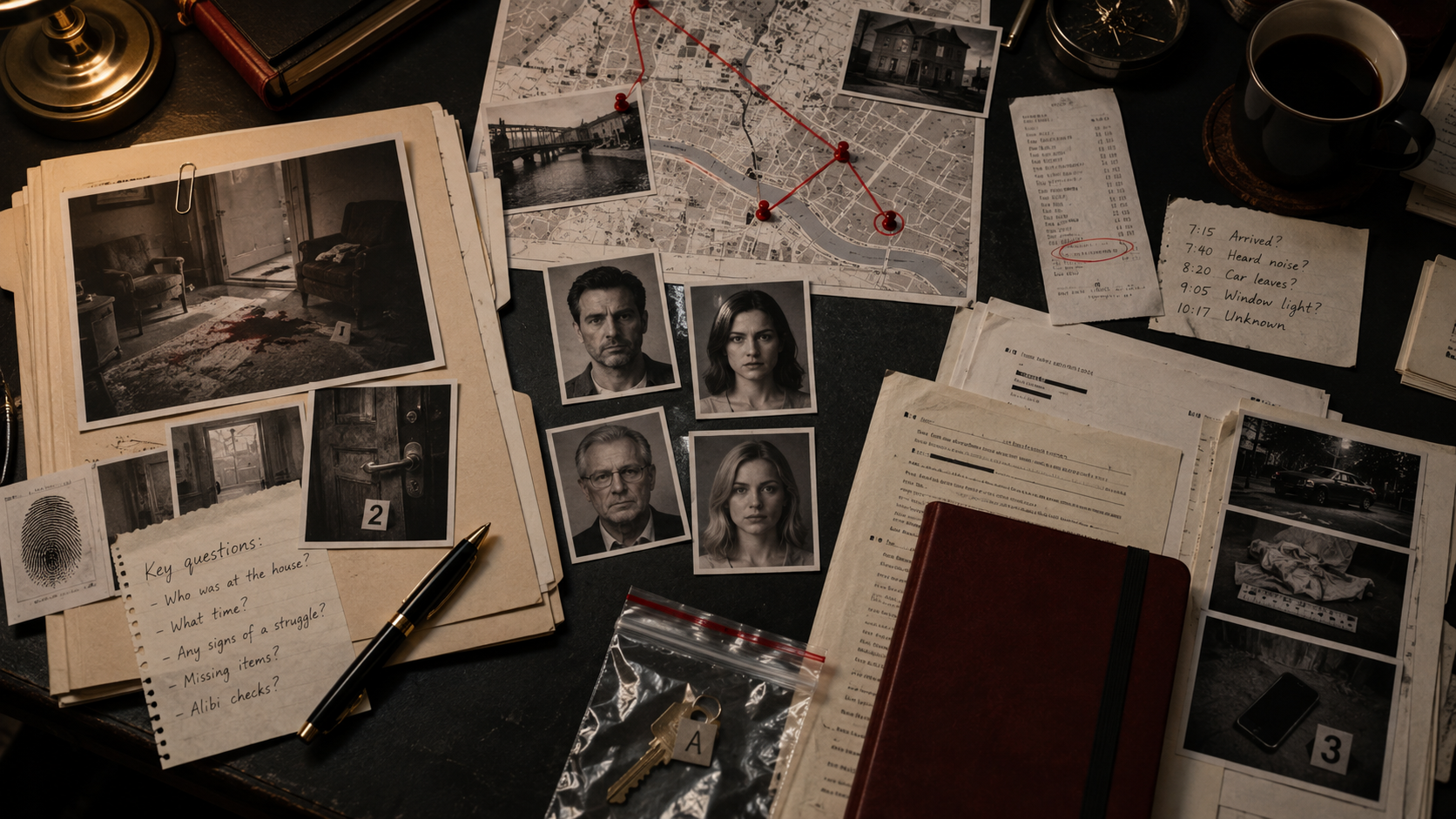
A murder mystery case file game is an investigation game that asks you to solve a fictional crime by examining evidence rather than acting out a character.
Instead of being assigned a role at a dinner party, you take the position of the investigator. You read reports, compare statements, examine photographs and records, reconstruct timelines, test alibis, and decide which theory best explains the evidence.
The appeal is simple: the story is already in motion when you arrive. Your job is not to perform it. Your job is to figure out what happened.
Case-file games can be printable, digital, physical, or a mix of formats. Some are designed for one player, while others work well for couples or groups. The exact structure varies from game to game, but the core experience is usually the same: gather information, separate useful clues from distractions, and build a case you can actually defend.
How Does a Murder Mystery Case File Game Work?
Most case-file games begin with an incident that has already happened. You are given the information an investigator might have access to and asked to determine the truth.
A typical investigation looks something like this:
- Read the initial case information and understand what happened.
- Review the available evidence, including reports, interviews, photographs, logs, maps, records, or other documents.
- Compare statements and timelines to find inconsistencies.
- Identify which clues support or weaken each theory.
- Decide who was responsible and explain how the evidence fits together.
- Submit your conclusion or reveal the official solution.
Some games give you every piece of evidence at the beginning. Others unlock additional material as you solve objectives or discover passwords, codes, or hidden connections.
The important distinction is that progress should come from what you notice and deduce. A strong case-file game should reward careful reading and cross-referencing rather than random guessing.
What Kind of Evidence Is Usually Included?
The evidence is what makes a case-file game feel different from simply reading a mystery story.
Depending on the game, you might encounter police-style reports, suspect interviews, witness statements, photographs, maps, receipts, phone records, financial documents, surveillance notes, emails, handwritten notes, forensic summaries, timelines, or other materials created for the investigation.
Not every document should point directly toward the answer. Some evidence exists to provide context. Some clears a suspect. Some creates a contradiction. Some looks important at first but turns out to be a red herring.
The challenge is deciding what matters and how separate pieces of information connect.
In a well-designed case, the evidence should eventually support one coherent explanation. You may have several plausible theories along the way, but the final solution should not depend on information that was never available to you.
Case-File Games vs. Murder Mystery Parties
These two experiences are often grouped together because both involve solving a fictional murder, but they play very differently.
A traditional murder mystery party is usually a social role-playing experience. Players are assigned characters, given information to reveal, and often encouraged to dress up or stay in character. The entertainment comes partly from the performance and interaction between players.
A case-file game usually removes that performance layer.
Nobody needs to play the victim’s business partner, suspicious neighbor, secret lover, or corrupt employee. Instead, everyone can work on the same side as investigators.
That makes case-file games especially appealing if you enjoy deduction but do not want to act, host a large event, prepare costumes, or manage character scripts.
It also makes the format flexible. A case can often work as a quiet solo investigation, a two-person date night, or a group activity where everyone debates the evidence together.
Case-File Games vs. Escape-Room Games
Case-file games and escape-room games can overlap, but they usually emphasize different skills.
Escape-room-style games often focus on solving a sequence of puzzles. A cipher might reveal a number, that number might open a lock, and the contents of the lock might lead to the next puzzle.
A case-file investigation is usually more focused on explanation.
Why does one person’s timeline conflict with a receipt? Why does a witness describe something that could not have happened at that time? Why does a forensic detail support one theory but rule out another?
You may still encounter codes, passwords, or unlocks, but they work best when they support the investigation rather than replace it.
If your favorite part of a mystery is asking, “What actually happened, and can I prove it?” a case-file game is probably closer to the experience you are looking for.
Printable, Digital, or Physical: Which Format Is Best?
There is no single best format. The right choice depends on how you like to play.
Printable case files are usually delivered as digital files that you can print at home. They are convenient because you can start quickly and spread the documents across a table like a real investigation.
Digital case files can be viewed on a computer, tablet, or other device. They reduce printing and can make it easier to include interactive elements, online evidence, video, audio, or password-protected material.
Physical boxed games arrive with printed documents and sometimes additional props or tactile evidence. They can feel more immersive straight out of the box, but they usually require shipping and storage.
Some games combine these formats. You might receive printable documents while also using a website to unlock additional evidence, request hints, or submit your final answer.
Before buying, check whether the experience requires printing, whether digital viewing is supported, and whether any online elements are required.
Can You Play a Case-File Game Alone?
Many case-file games can be played solo because the investigation does not depend on other players performing characters.
Solo play gives you complete control over the pace. You can take detailed notes, reread documents, and follow every lead yourself.
With two players, the experience becomes more conversational. One person may notice a timeline problem while the other spots a detail in an interview. That makes case-file games a natural fit for couples who want something more interactive than watching a movie but less structured than hosting a full game night.
Groups can work well too. Players can divide the evidence, compare observations, and argue different theories before agreeing on a final conclusion.
The important thing is to check the recommended player count for the specific game. A very small case can become crowded with too many people, while a large evidence-heavy investigation may benefit from extra eyes.
How Long Do Murder Mystery Case-File Games Take?
Playtime varies considerably.
A short case may be designed for a quick evening, while a deeper investigation can take several hours. Reading speed, group size, difficulty, and how thoroughly you examine the evidence can all change the actual playtime.
The listed estimate should be treated as a guide rather than a deadline.
For many players, part of the fun is slowing down when something feels important. You may build a timeline, reorganize documents, revisit an interview, or debate a theory before moving on.
If you are choosing a case for a date night or scheduled game night, check the estimated playtime before starting and leave some extra room if your group likes to discuss every possibility.
What Makes a Good Case-File Mystery?
A satisfying case is not just difficult. It is fair.
The strongest investigations give you enough information to reach the answer without making the solution obvious too early.
Good red herrings should be plausible but ultimately testable. A suspicious character can have a strong motive without being the killer, but there should be evidence that allows a careful player to eliminate that person.
Contradictions should matter. Timelines should hold together. Forensic details should have a purpose. The final explanation should account for the major evidence instead of ignoring inconvenient pieces.
Most importantly, the solution should feel earned.
The best ending is not, “I never could have known that.”
It is, “That was there the whole time.”
What Should You Look for Before Buying?
Before choosing a case-file game, look at the practical details as well as the theme.
Consider the player count, estimated playtime, difficulty, delivery format, printing requirements, hint system, and whether the game includes online components.
Also look at how the game describes its style of play. Some case files lean heavily into puzzles and codes. Others focus on realistic documents and deduction. Some are designed to be light and accessible, while others expect you to track subtle contradictions across a large amount of evidence.
Neither approach is automatically better. The goal is to choose the kind of investigation you actually enjoy.
If you want a serious detective experience, look for a game that emphasizes evidence, timelines, suspect statements, and a solution that can be supported by the materials in front of you.
How CasePursuit Approaches the Format
CasePursuit is built around evidence-driven investigation rather than character acting.
In the Core Series, the goal is to make you work for the solution by comparing documents, testing theories, clearing red herrings, and finding the explanation that fits the full pattern of evidence.
Last Call at Blackwood Lounge, Case File 001, is a 1+ player investigation built around more than 55 pieces of evidence and nine suspects. It can be printed for table play or reviewed digitally, and the investigation continues through online evidence unlocks before you submit your final conclusion.
The case is designed to take roughly 90 to 150+ minutes depending on how you play.
If that sounds like the kind of mystery you enjoy, explore Last Call at Blackwood Lounge or see how CasePursuit works before opening your first file.
Final Thoughts
A murder mystery case-file game is for people who would rather investigate the story than act it out.
You are given the evidence, the suspects, and the contradictions. What you do with them is up to you.
Whether you play alone, with a partner, or around a table with friends, the best case-file games create the same feeling: there is an answer hidden somewhere in front of you, and if you pay close enough attention, you can prove it.